Coding is the process of assigning a symbol to an action in order for a computer to de-code the system and perform specific functions in relation to these symbols. Computational thinking is efficient problem-solving, thinking recursively (Wing 2006 p.34), planning, learning and researching. Computational thinking is behind every action we do and the mental processes we undergo. What is important to note however is that coding and programming is NOT the same as computational thinking. Students who are competent at programming foster their computational thinking skills although the two things do not occur concurrently.
Recently, government bodies across the world have tuned into the importance of computational skills across the curriculum, this has been seen in the Australian curriculum.
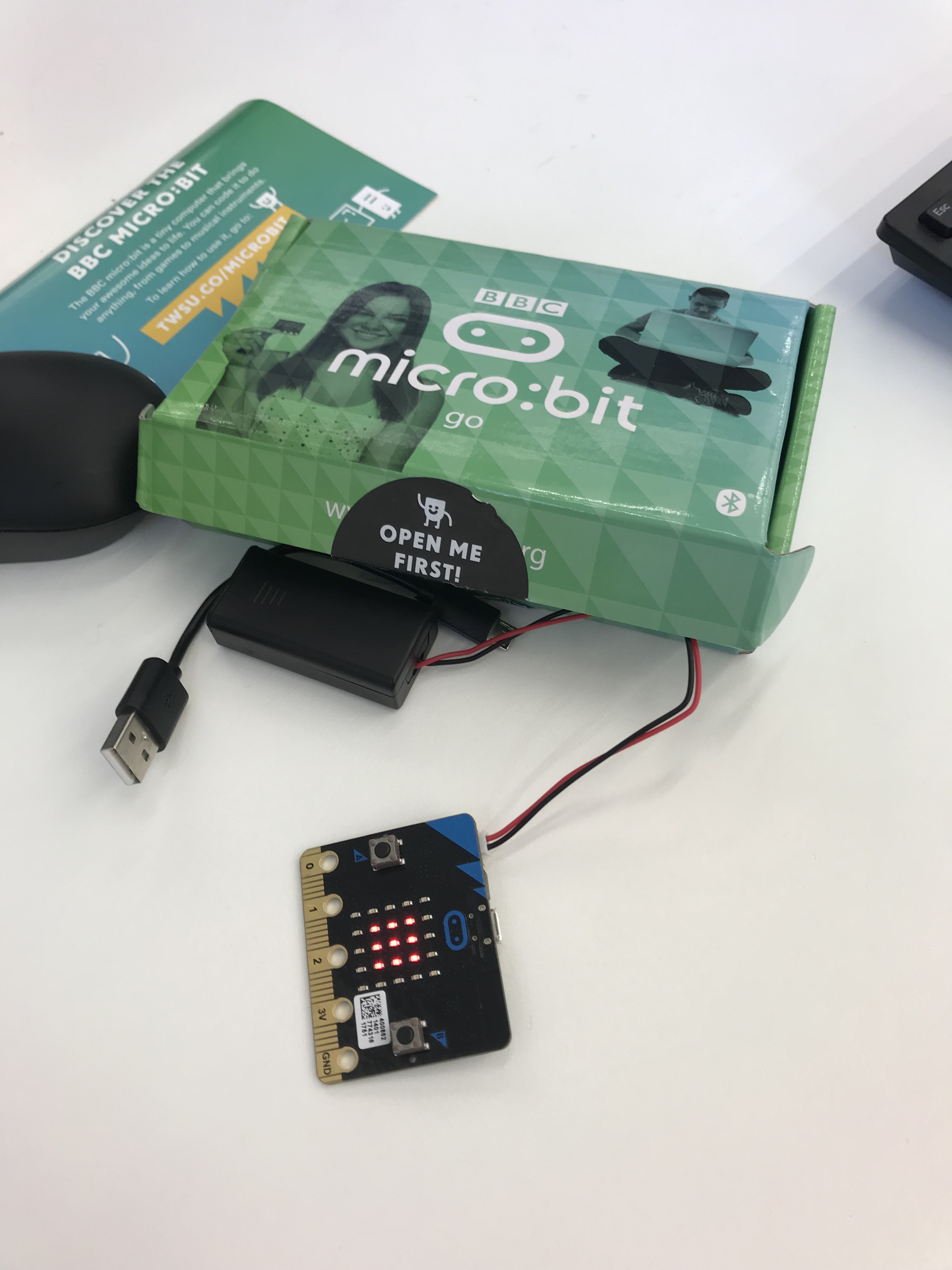
The micro-bit in action, playing scissor, paper, rock with its inbuilt motion detector.
The micro-bit is a pocket-sized programmable computer (BBC) which was created to inspire creativity. In the UK the micro-bit is provided to all students who are in year seven or above to develop the new generation of “tech pioneers”. It is easy to use, as students can learn how to light up the LED’s or display a pattern without needing to know much about computers. Some of the features of the micro-bit include 25 LED flashlights which can be programmed to do different things, input and output rings to connect the micro-bit to a computer, a motion detector and a built in compass. They are a great, easily accessible piece of technology which can be used in the classroom to develop computational thinking skills through programming.
When creating solutions, students define problems clearly by identifying appropriate data and requirements. When designing, they consider how users will interact with the solutions, and check and validate their designs to increase the likelihood of creating working solutions.
Australian Curriculum and Reporting Authority (ACARA)
In the subjects of mathematics, STEM, science and engineering, it is vital for students to not just acquire content knowledge but also engage in practice through programs such as the micro-bit. While the micro-bit technology may be more suited towards primary aged students, it is foundational to engaging students from a young age towards STEM based subjects. Therefore, the initial lessons which they learn about coding, later develop into computational thinking, where students are competent at solving problems efficiently and can break down large complex tasks (Wing p.33). As educators, this is what we should strive for!
References
Wing, J. (2006). Computational thinking, Communications of the ACM, 49(3), pp.33-35.
Ryu, S., Lombardi, D. (2015). Coding Classroom Interactions
for Collective and Individual Engagement, Educational Psychologist, 50(1), 70-83.
ACARA. (2019). Digital Technologies. Retrieved from https://www.australiancurriculum.edu.au/f-10-curriculum/technologies/digital-technologies/.

 Grace's Blog