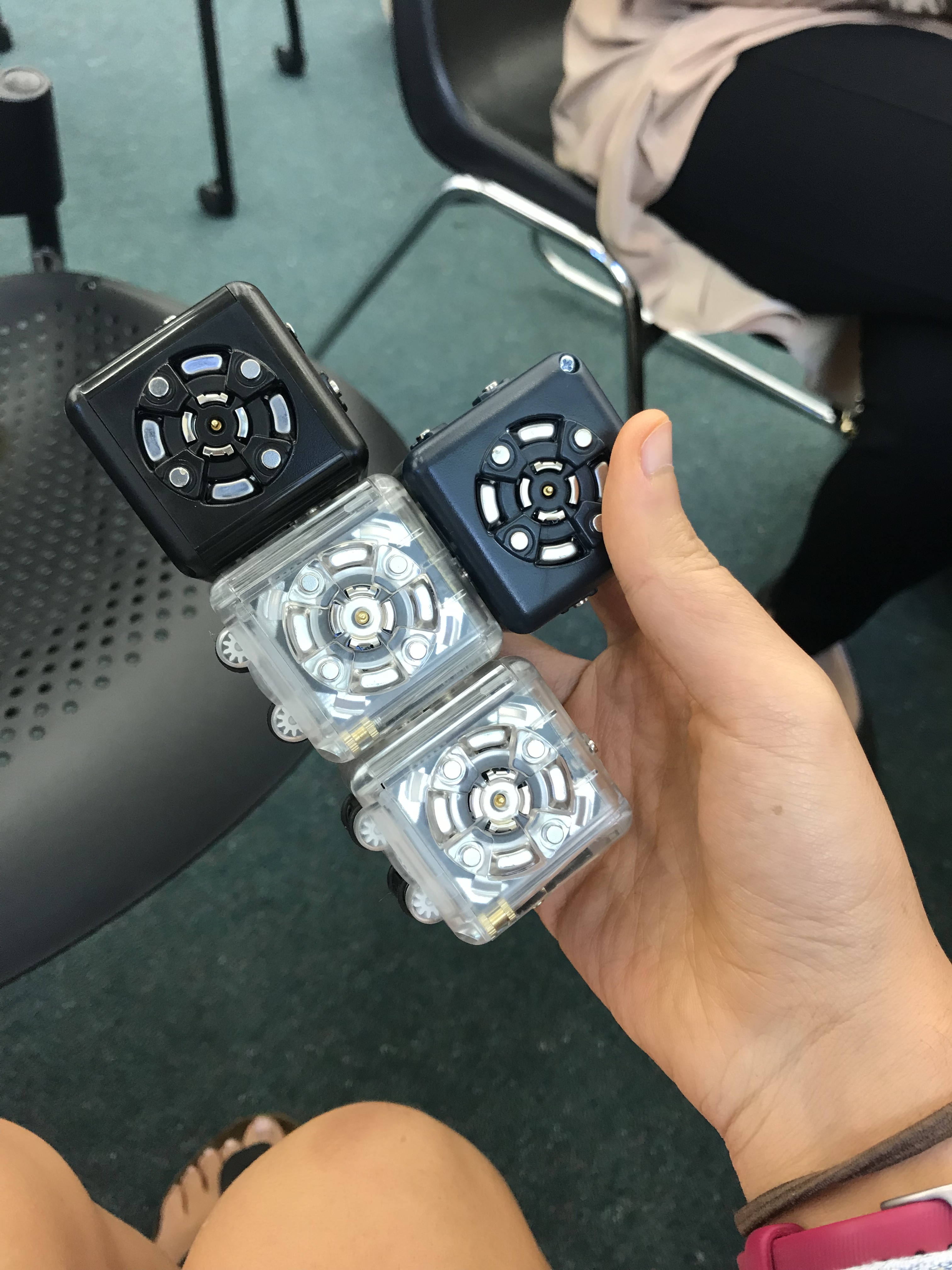
- magnets
- distance sensor
- light sensor
“Robotics education provides learners with practical experiences for understanding technological and mechanical language and systems; accepting and adapting to constant changes driven by complex environments; and utilizing knowledge in real situations or across time, space and contexts.”
(Jung and Won, 2018 p.5).
Cubelets are a type of robotic kit where students can program the different cubes to perform certain tasks. This robotic kit is really engaging as each cube serves a different purpose and therefore, they perform differently to stimuli. For example, one of the cubes has a sensor function and when paired with the moving cube can move towards or against sensed movement. The cubes are joined together through magnetism and there is a lot of free choice in regards to what shape the cubes make provided moving cubes stay connected to a surface.
There is a lot of research in regards to robotics in education, Alimisis (2012 p.9) explains that the emergence of robotics across education has something to do with the constructionist method of education, where students learn knowledge through building and deconstructing objects to encourage deep understanding. Alongside this, is the constructivist approach sees students as active creators of knowledge who build their own knowledge schemas. The teacher is therefore the guide as students explore and create. It is easy to see why robotics has been an effective way for students to create their own knowledge through being physically involved in programming actions for a robot to perform.
Alimisis (2012) states that teachers must have explicit training before teaching robotics to students. That although robotics is a great way for students to learn about coding and programming, teachers must give careful instructions and scaffold their expectations before allowing students to control their robot how they would like to. This includes, beginning a robotics class by exploring the features of a robot and challenging students to learn basic functions. Once this has been evidenced, students can move on to transform the robotics activity to something of their choice. As well as this, Jung and Won (2018) state the importance of having robotics activities carefully thought out with links to the curricula, instructional activities and learning objectives as often the purpose of using robots can be mixed up in the instruction to students.
References:
Jung, S.E., Won, E. (2018). Systematic review of research trends in Robotics education for Young Children, Sustainability,Vol.10, pp.1-24.
Alimisism, D. (2012). Robotics in Education & Education in Robotics: Shifting focus from Technology to pedagogy, Robotics in Education, p.7-14.

 Grace's Blog