In the game Turing Tumble, players must use problem-solving techniques to build a path for the balls to come down a specific path, ensuring that they meet the output required by the manual book. Turing Tumble is not just a game about coordination, but rather, requires the player to plan, compose and build a path for the ball to complete. The game is engaging and interesting and the manual book included a comic for students to read as they solved each puzzle. Each level included a starting position for all the blocks as well as informing you of the pieces you would be allowed to use to solve the puzzle.
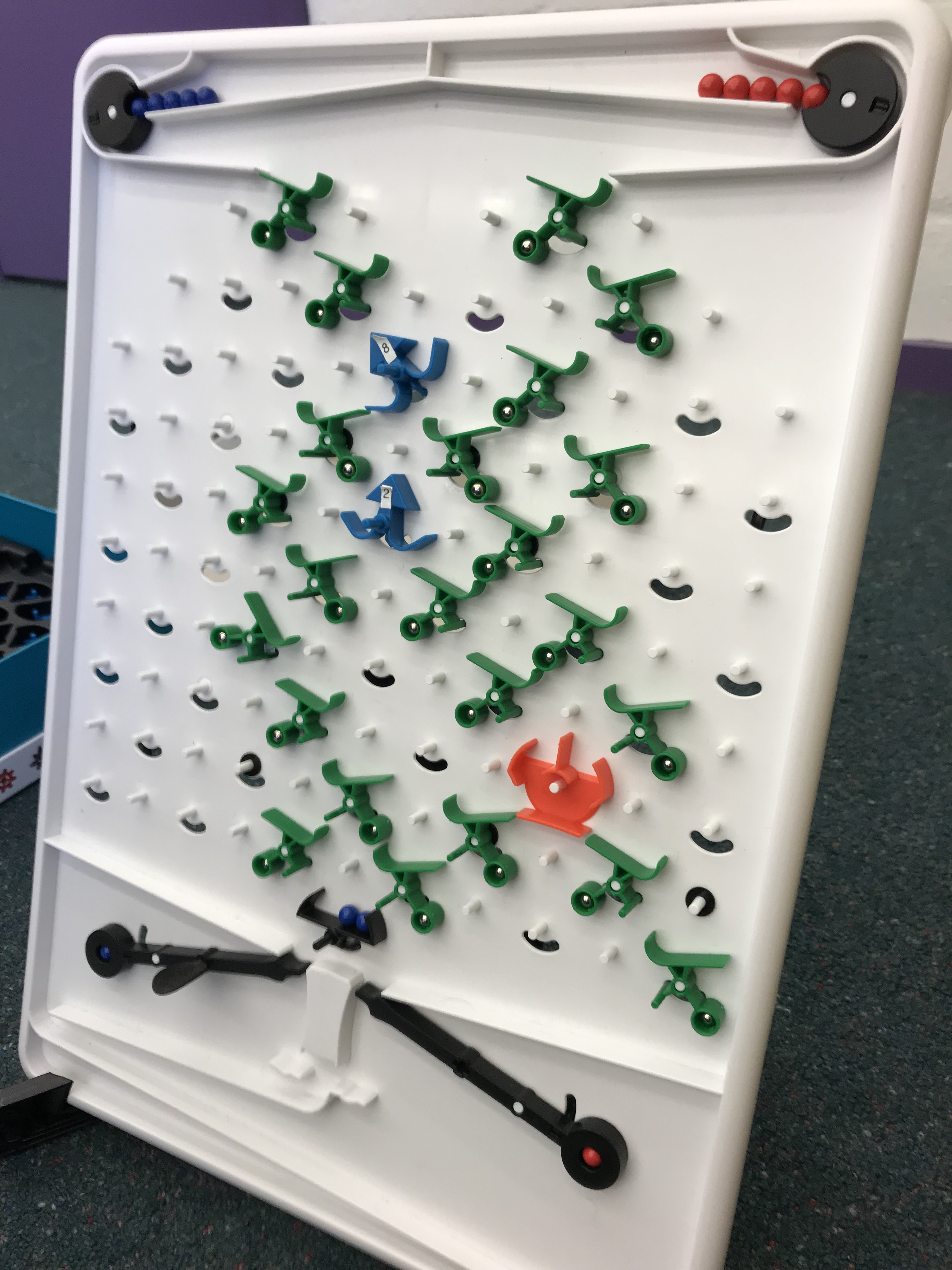
An example of one of the levels, the output needed to be alternating blue and red balls.
On the turing tumble website it states “computers are full of ingenious logic and astonishing creativity…with Turing Tumble you can see how computers work” (https://www.turingtumble.com/), through the inclusion of many pieces which have different functions, students must consider the different paths of the balls and their required output before adding pieces to the path. As students are required to piece together a path for the ball, they are involved in constructing and deconstructing a path to fulfil a specific purpose. The term ‘constructionism’ was derived from Papert (1991) and relates to the idea that children learn best when they are involved in making something themselves rather than being presented with knowledge and answers directly. Constructionism challenges the ideas of the 21st century, where students are constantly consuming knowledge and rather, invites them to be co-creators of knowledge through building and collaborating with others. While constructionism is often confused with constructivism, the two learning concepts do have a few things in common (Groff 2013), that is that authentic learning occurs when building onto prior knowledge structures in meaningful ways.
The Australian Curriculum, Assessment and Reporting Authority state that “in a world which is digitised and automated, it is critical to the wellbeing of society that students can be creative and discerning decision-makers” (ACARA, 2019), through using Turing Tumble, students can experience deep knowledge and understanding of digital systems while also being involved in creating this knowledge through a hands-on approach. It is imperative also that educating students about digital technologies also includes opportunities for offline tasks, which foster curiosity, creativity, persistence and cooperation and ‘Turing Tumble’ can fulfil all of those qualities.
References:
Australian Curriculum, Assessment and Reporting Authority. (2019). Rationale: Digital Technologies, retrieved from https://www.australiancurriculum.edu.au/f-10-curriculum/technologies/digital-technologies/rationale/.
Donaldson, J. (2014). The Maker Movement and the Rebirth of Constructionism, Hybrid Pedagogy, retrieved from http://hybridpedagogy.org/constructionism-reborn/.
Dougherty, D. (2015). The Maker Mindset, retrieved from https://llk.media.mit.edu/courses/readings/maker-mindset.pdf.
Groff, J. S. (2013). Expanding our “frames” of mind for education and the arts. Harvard Educational Review, 83(1), 15–39.
Martinez, S. (2019). The Maker Movement: A Learning Evolution, International Society for Technology in Education.
Papert, S., & Harel, I. (1991). Preface. In I. Harel & S. Papert (Eds.), Constructionism: Research reports and essays, 1985–1990, 1-23.

 Grace's Blog